01
Solar Photovoltaic
Primary outbound energy
Flexible perovskite skin wraps the envelope. Powers thrusters, ion heating and condensation; surplus is pushed into the reserve.
200–400 W/m² at altitude
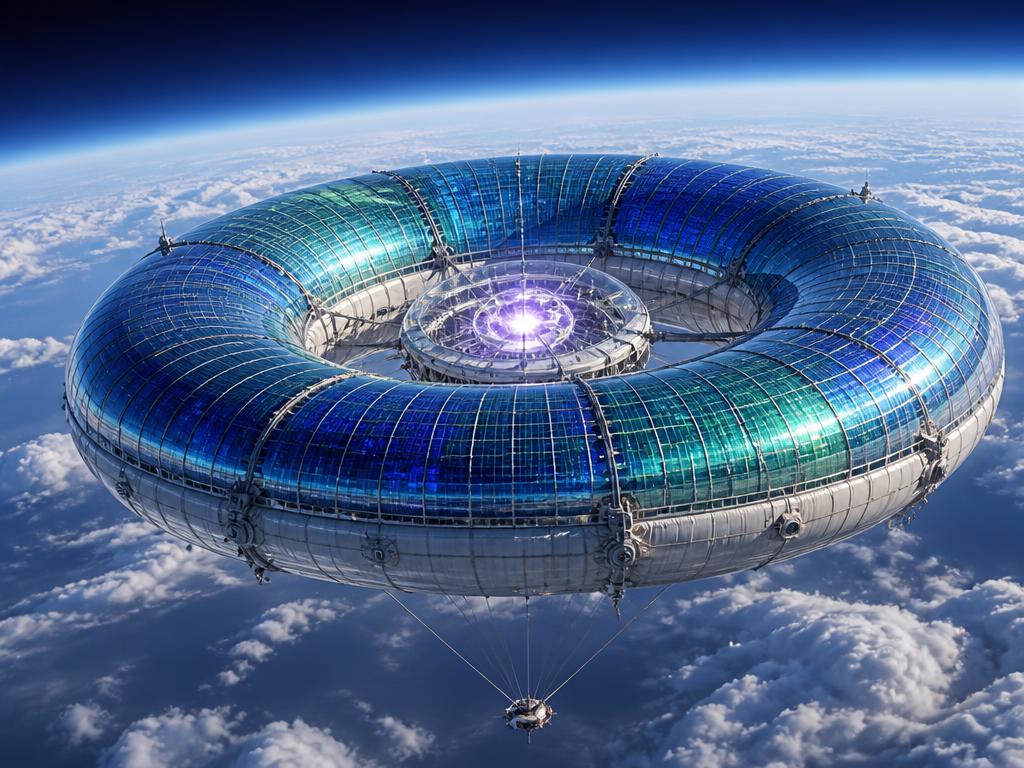
Toroform Aerostatics
A hybrid balloon-drone built as a torus: energy flows outward from a central axis, does work at the perimeter, and returns to the core. Five harvesting streams, one induction hub, indefinite station-keeping.
Not subsystems. Nodes on a single circulation path — each one closing back into the toroidal induction core.
Primary outbound energy
Flexible perovskite skin wraps the envelope. Powers thrusters, ion heating and condensation; surplus is pushed into the reserve.
Ambient trickle
Embedded antenna mesh captures atmospheric RF and the ionospheric potential gradient — modest, but continuous day and night.
Passive static accumulation
The internal helium bladder expands and contracts against a charged mesh every 5–10 minutes, building charge that discharges into the coil.
Energy in, gas out
Condensation plus electrolysis splits water into hydrogen lift and stores the remainder as adjustable ballast.
Variable capacitive coupling
Altitude changes vary the craft's capacitance against the sky. Slow transitions siphon charge into the induction core.
Move the sliders and watch the loop respond: harvest, demand, and whether the circulation actually closes.
Active mode
Solar Cruise
Net +629.7 W
Inflow
Outflow
3 kWh reserve, integrated hour by hour at the current configuration.
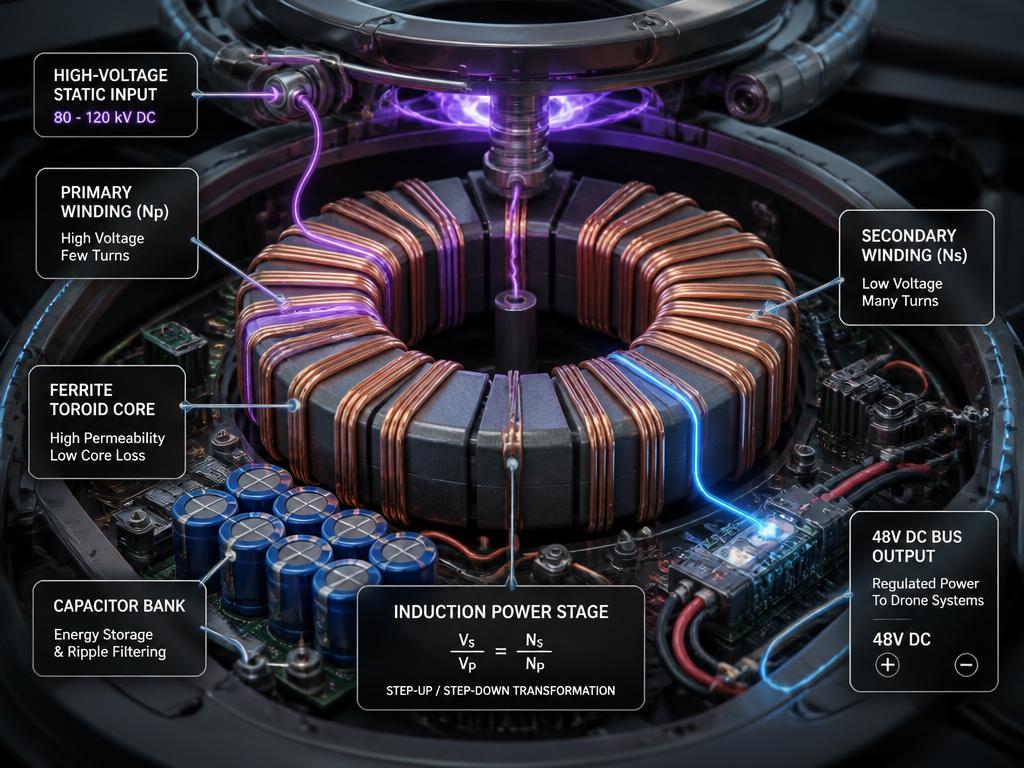
Where every stream converges and steps down into a usable low-voltage bus.
Lung static reaches ~10 kV
Capacitor bank releases a controlled micro-pulse
Primary coil snaps a magnetic field into existence
Secondary winding induces high-current, low-voltage output
24 V / 48 V DC to reserve and avionics
Mode A
Day
Mode B
Night / low sun
Mode C
Storm / emergency
Four views of the craft closing its own energy loop — from solar cruise to storm descent.
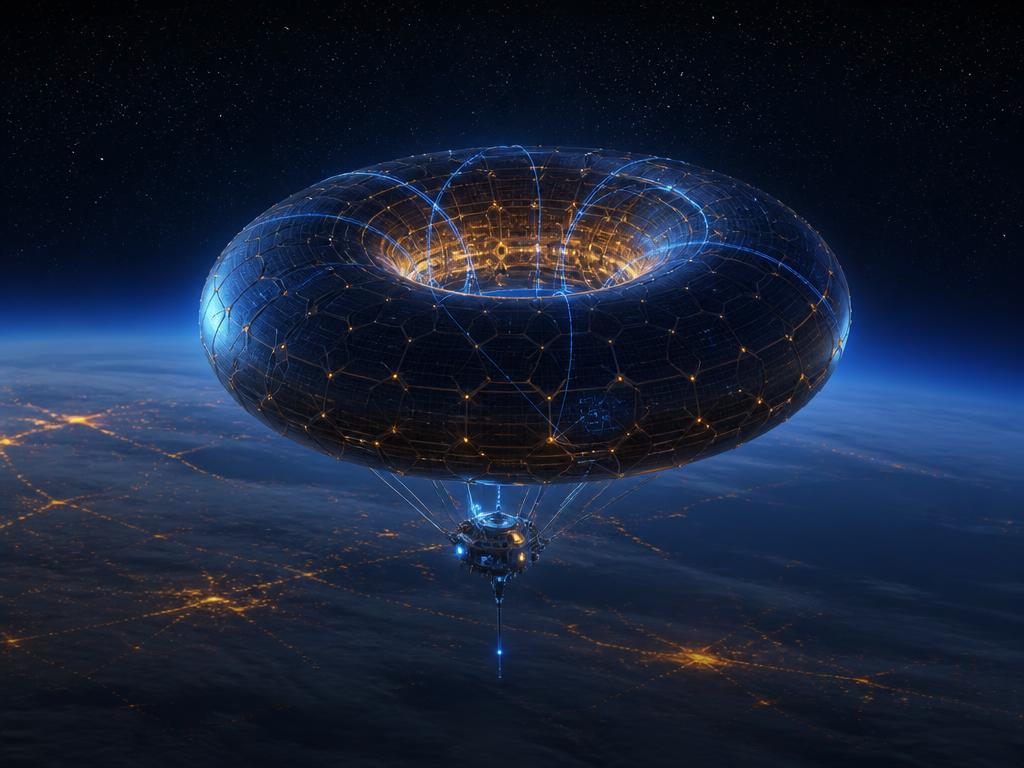
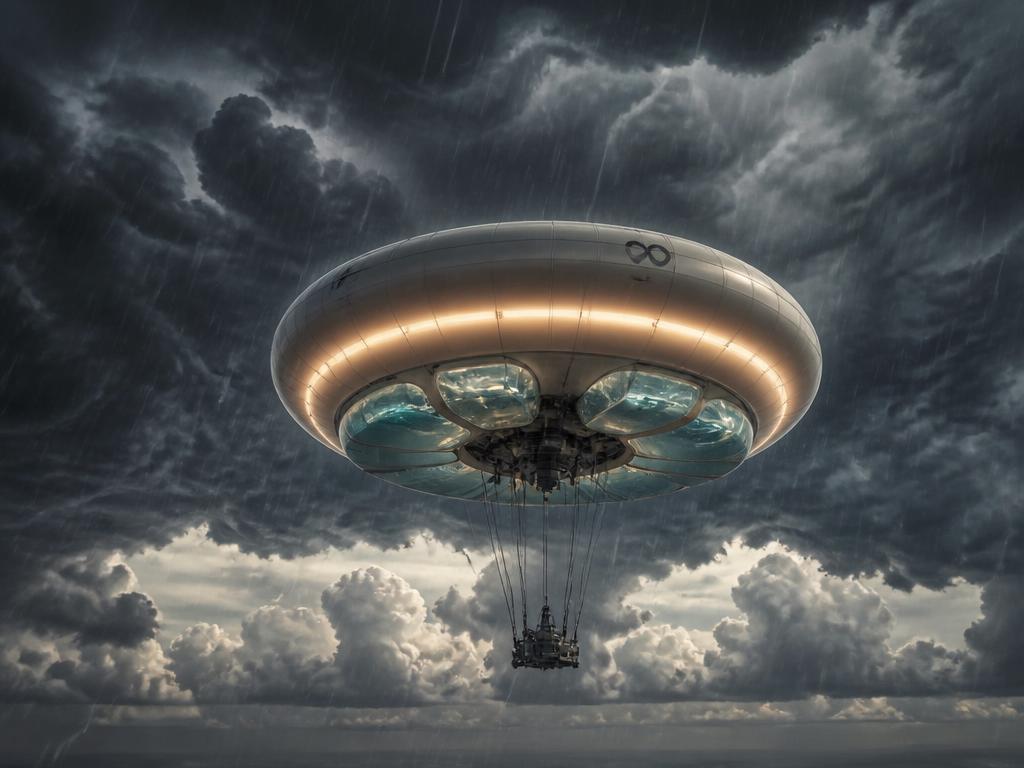
25 kg payload, 5 m³ helium envelope. The night bottleneck is real: rectenna plus lungs deliver 5–20 W sustained, so the craft must drift. We size a 2–4 hour hover reserve to bridge it.
| Component | Draw | Source | Balance |
|---|---|---|---|
| Thrusters (hover) | 150 W | Solar (day) | Sufficient |
| Ion propulsion (cruise) | 80 W | Solar (day) | Sufficient |
| AWG condensation + electrolysis | 60 W | Solar (excess) | Marginal |
| Navigation & avionics | 10 W | Battery / trickle | Covered |
| Parasitic losses | ~20 W | All sources | Distributed |
| Night / low-light hold | −50 W | Rectenna + lungs | Tight |